
Aquarium heater stuck on: the signs and what to do
Heaters and thermostats fail, and the worst way they fail is stuck on. Here is how to spot it, how to cool the tank without making things worse, and how to set up so a single failure can't cook it.
Why it happens
Most aquarium heaters have a built-in thermostat that switches the element on and off. If that switch fails in the on position, the heater keeps heating regardless of the dial, and the water keeps getting warmer until someone notices.
The RSPCA's advice for fishkeepers is blunt: just as with any electrical equipment, thermostats and heaters can fail, so use a digital thermometer and check the temperature every day.
The signs
Check the thermometer first. Behaviour comes later and is less specific.
- The thermometer reads above your usual temperature, and keeps rising.
- The heater's light stays on all the time, when it would normally cycle on and off.
- Fish hanging at the surface or breathing fast. Warm water holds less oxygen: the US Environmental Protection Agency notes that higher temperatures reduce how much oxygen water can hold.
- Corals or plants looking stressed in a planted or reef tank.
What to do now
Practical Fishkeeping's advice for an overheated tank is to cool it gradually. Sudden temperature changes can be more dangerous to fish than a tank that is too warm.
- Switch the heater off at the plug and take it out of the water once it has cooled.
- Switch off the lights and open the hood or lid, so heat can escape.
- Add aeration, such as an air pump and airstone, to raise the oxygen level.
- If you feel you must do a water change, change no more than 20%, and aim to drop the temperature by a couple of degrees, not to use very cold water.
- Then let the tank cool naturally, and keep checking the thermometer.
Know your fish's range
Different fish need different temperatures, so set the heater for the species you keep. The RSPCA gives two examples: guppies can tolerate 22 to 28°C, while loaches need 18 to 26°C. Goldfish need 10 to 21°C, so a heater usually isn't necessary for them.
Knowing the top of your fish's range tells you when 'a bit warm' has become a problem.
Remember that the water also warms up on its own in a heatwave, and a heater that is working perfectly can't cool it. The same steps, lights off, lid open and extra aeration, help in hot weather too.
Protect the tank next time
None of these is expensive compared with restocking a tank.
- Keep an independent thermometer in the tank, away from the heater, and read it daily, as the RSPCA advises.
- Consider two smaller heaters instead of one large one. Practical Fishkeeping suggests this, because if one fails in the on position it heats the tank more slowly.
- Or put the heater on a separate temperature controller that cuts the power if the water gets too warm.
- Replace a heater that looks burnt, cracked or discoloured.
- Use a monitor that tells your phone when the water passes a limit, so a failure while you're out or asleep doesn't go unnoticed.
Where Haldrea fits
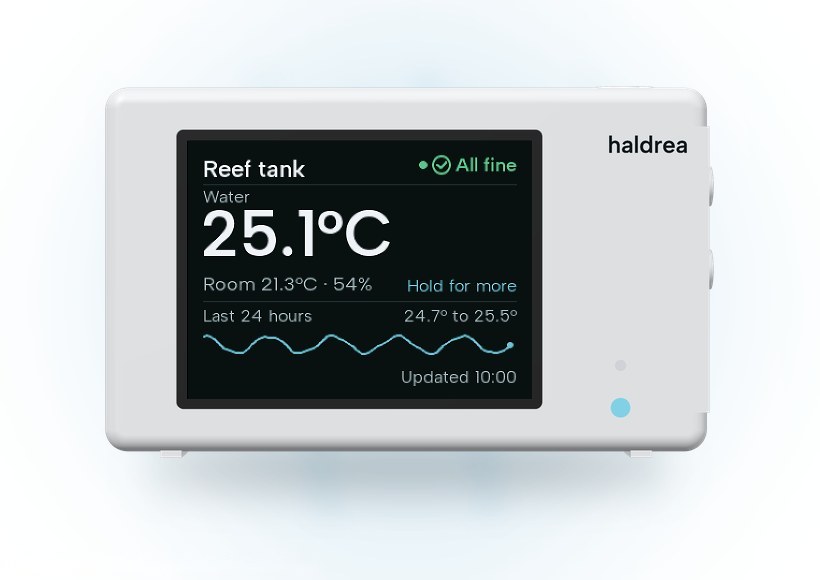
Haldrea is a small Wi-Fi temperature monitor. The water probe sits in the tank on its own mount, separate from the heater, and Haldrea tells your phone when the water goes outside the limits you choose, whether the heater has stuck on or failed off. A rechargeable backup battery inside keeps Haldrea measuring through a power cut, and your phone is told: at once if your router still has power, or, if we stop receiving readings because the router is down too, after about 10 minutes.
Questions
How do I know if my aquarium heater is stuck on?
The thermometer keeps rising above your set temperature and the heater's light stays on all the time. Unplug it and check the water.
How do I cool an overheated fish tank safely?
Gradually. Practical Fishkeeping advises switching off the lights, opening the lid, adding aeration, and changing no more than 20% of the water, aiming to drop the temperature by a couple of degrees.
Why are my fish gasping at the surface?
It can have several causes. One is warm water, which holds less oxygen. Check the temperature first.
Sources
- RSPCA: Choosing an aquarium for pet fish
- Practical Fishkeeping: How to stop a tank from overheating
- US Environmental Protection Agency: Dissolved oxygen (CADDIS)
- Haldrea (haldrea.com)
Haldrea is £99. Where to buy